The kitchen drawer is not an archive
A rubber band, a manila envelope, and thirty years of irreplaceable documents: why physical storage fails families who live across borders and time zones.
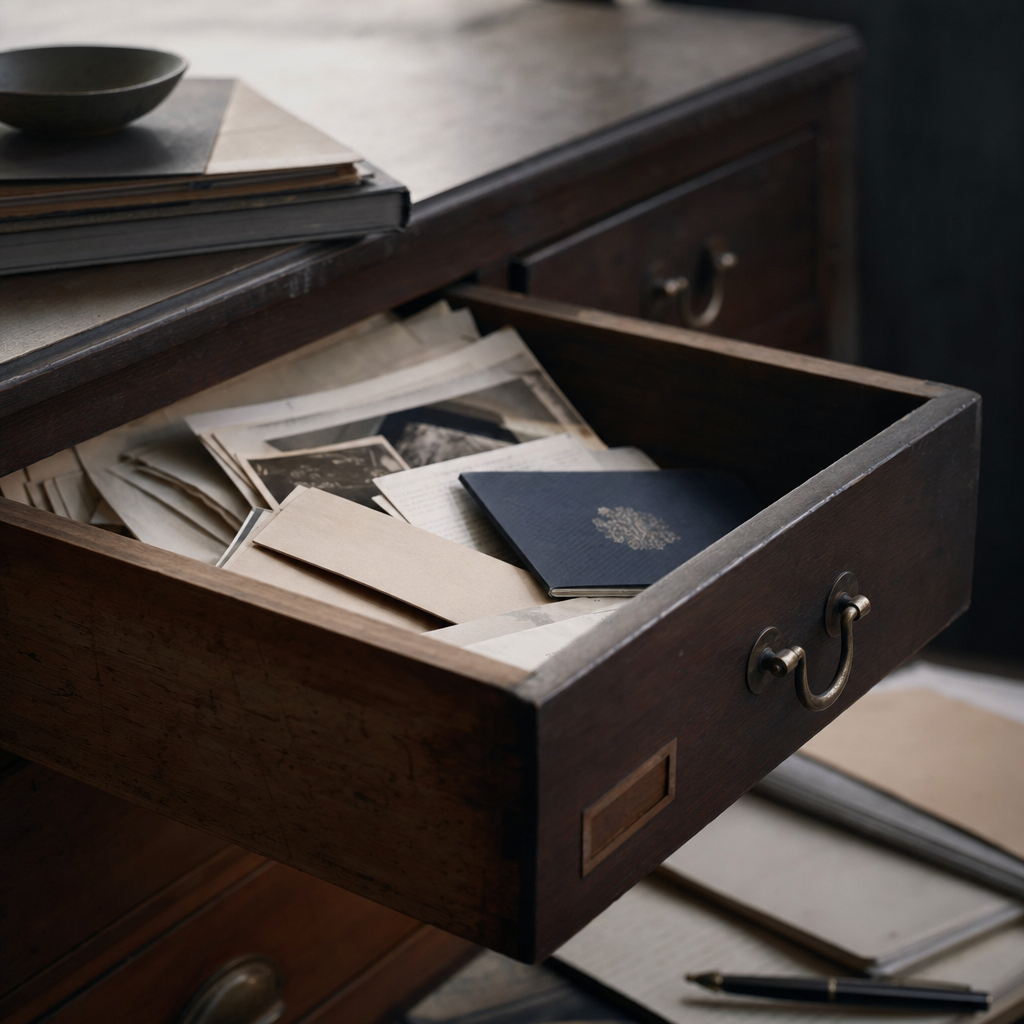
Somewhere in the house, usually a drawer in the kitchen, occasionally a shoebox on a wardrobe shelf, there is a collection of papers that represents a family's entire administrative existence. Birth certificates. Passport scans. A will printed on A4 and signed in blue biro. The deeds to a property bought in 1998. Perhaps a life insurance policy whose premium has been paid by direct debit for so long that nobody remembers the provider's name.
It works, after a fashion, until it doesn't. A kitchen flood from a burst pipe. A house fire that takes forty-five minutes and one room before the brigade arrives. A parent who falls seriously ill abroad and whose children, scattered across three countries, need power of attorney documents today, not after someone has driven to the family home, searched the drawer, and worked out that the solicitor who drafted the document retired in 2019.
The drawer is not a failure of character. It is a 1980s answer to a problem that has become considerably more complicated since then.
What physical storage actually costs
The obvious risks are fire and flood, and they are real. The Association of British Insurers records thousands of domestic fire claims each year in which documents are listed among the losses. But the subtler cost is access, or rather, the absence of it at the moment it is needed most.
Consider the geometry of a modern family with means: a primary residence in London, a second property in Portugal, children at university in the Netherlands, and a parent wintering in Florida. When something goes wrong, a sudden incapacity, a death, a legal dispute over an asset, the critical documents need to be in the right hands within hours, not days. A drawer in Kensington is not accessible from Lisbon at two in the morning.
Photocopying and emailing documents to various family members, which many people do as an informal workaround, creates its own problems. Copies proliferate across inboxes with no version control. An amended will sits alongside an older draft, and nobody is certain which supersedes the other. A passport scan forwarded in 2019 is still floating in someone's Gmail, readable by anyone who gains access to that account.
Storing scans in a general cloud service, a shared folder in Dropbox, a Google Drive shared with a spouse, is meaningfully better than the drawer, but it is not purpose-built for this function. There is no structure enforcing what documents belong, no record of who accessed what and when, and no mechanism for ensuring that the right people gain access automatically if the account holder is incapacitated or dies.
What end-to-end encryption means in practice
The phrase appears often enough in technology marketing that it has begun to lose meaning. In the context of a family vault, it warrants careful examination.
End-to-end encryption means that documents are encrypted on your device before they leave it, and decrypted only on an authorised recipient's device. The service provider, the company running the vault, holds no key that would allow it to read your files. Not during storage, not during transmission, not in response to a subpoena that does not compel you directly. The practical implication is that a data breach at the infrastructure level exposes ciphertext: numerically meaningless without the keys that only your family controls.
This matters for documents of the kind families actually store. A will is a map of an estate. A trust deed names beneficiaries and the assets held for them. Passport scans are sufficient for identity fraud. In the wrong hands, any of these documents causes harm that is difficult and sometimes impossible to reverse. Encryption is not a feature; it is the minimum condition for taking the problem seriously.
Beyond encryption, the architecture of access matters as much as the protection of contents. A well-designed vault distinguishes between a document's owner, those granted read access, and those who assume access only upon a defined event, the verification of incapacity, the registration of a death. This is succession logic: the document exists not merely to be stored but to be found and acted upon by the right person at the right moment, without requiring that person to know a password or locate a physical key.
The manila envelope in the kitchen drawer contains genuine intention. Someone put those papers there because they understood, however dimly, that this information matters and should be findable. The question is whether the container is worthy of the contents, whether it can survive a flood, travel across borders in a moment, and reach your daughter in Amsterdam or your solicitor in Edinburgh without a phone call to someone who may not be reachable.
Thirty years of a family's administrative life deserves better than a rubber band and a drawer that sticks in damp weather.
If this is a gap in your own arrangements, Glenvault was built to close it, you can create a private vault at glenvault.com/signup.
The private vault for your family
Documents, wealth and succession protocols in one quiet, encrypted home. Start free — no card required.
Sign up to Glenvault