The twelve documents every UK household should find in five minutes
From passports to lasting powers of attorney, knowing where your critical documents live is the quiet foundation of every well-ordered family estate.
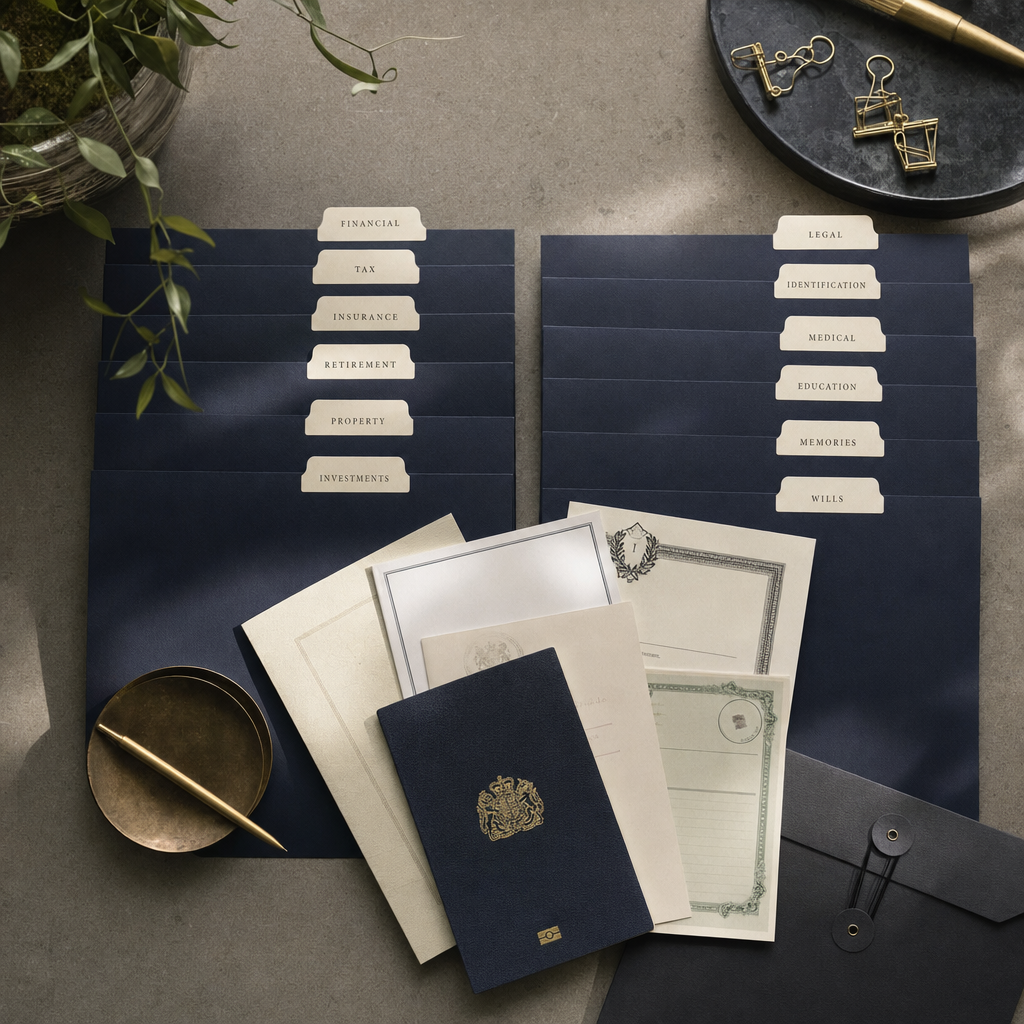
Imagine a solicitor rings on a Tuesday afternoon to say probate needs to begin. Your father passed yesterday. The will exists, you know that much, but where exactly? The filing cabinet in the spare room holds seven years of broadband bills. The safe has a combination no one wrote down. The clock, already running on grief, starts running on paperwork too.
That scenario is not rare. It is, in fact, the common version of events. The practical argument for organising your documents before they are urgently needed is not about pessimism. It is about choosing, in a quiet moment, to spare the people you love a chaotic one.
Below is a working list of the twelve categories that matter most to a UK household, followed by a method for bringing order to them.
The twelve categories
1. Passports. One per person, current and expired. An expired passport is still useful proof of identity in many administrative processes and should not be discarded without thought.
2. Birth certificates. Original, full certificates for every family member. Long-form, not the short extract. Solicitors, the Passport Office, and the General Register Office all ask for the long version at some point.
3. Marriage or civil partnership certificate. The original document issued on the day. A certified copy can be obtained from the General Register Office if the original is lost, but obtaining it takes time you may not have.
4. The will. The most recent, signed version for each adult in the household. If a solicitor holds the original, note their details here. Know whether it has been updated since any significant life event, because an outdated will can create as many problems as no will at all.
5. Lasting Powers of Attorney. Both types: property and financial affairs, and health and welfare. If these have been registered with the Office of the Public Guardian, keep the OPG-stamped originals accessible. Without a registered LPA, family members have no legal authority to act if you lose capacity, regardless of relationship.
6. Property deeds and Land Registry documents. For registered land in England and Wales, the title register is held by HM Land Registry and can be retrieved digitally, but the original conveyancing documents, including any restrictive covenants or transfers, are worth retaining. For unregistered land, the deeds are the only proof of ownership.
7. Mortgage documents. The original offer letter and any subsequent product transfers. Helpful for executors and, during your lifetime, for remortgage discussions.
8. Buildings and contents insurance policies. The full policy document, not just the certificate. Note the renewal dates and the insurer's claims line. Life insurance and critical illness policies belong here too, with the trust nominations if applicable.
9. Pension details. Workplace and private pension provider names, policy numbers, and nominated beneficiary forms. Expression of wishes forms are particularly important: they are not legally binding, but pension trustees give them significant weight when deciding where death benefits go.
10. NHS and private medical records summary. Not the entire file, but a summary: GP surgery, NHS number, any significant diagnoses or ongoing treatments, private health insurance policy details. In an emergency, this information needs to be findable in seconds, not hours.
11. Tax and HMRC correspondence. Unique Taxpayer References for anyone who completes a self-assessment return. P60s for the last few years. Any correspondence about inheritance tax planning or trust arrangements.
12. Utility and financial account index. Not the statements themselves, but a note of which banks, investment platforms, and utility providers the household uses. Executors need to notify these institutions; without a list, finding them all takes weeks.
A calm method for getting there
The goal is not a perfect archive built in a weekend. It is a reliable system assembled over a few evenings.
Start with location. Assign one physical place, a fireproof box or a dedicated drawer, for original documents. Originals stay in one place. Copies and digital scans can live elsewhere.
Scan as you go. Every document that passes through your hands gets scanned and filed in a folder structure that mirrors the twelve categories above. A naming convention helps: surname_document-type_year is enough.
Tell the people who need to know. The most beautifully organised document store is worthless if your spouse, adult children, or executor does not know it exists. A brief note, held with the will, that explains where everything lives is itself a document worth creating.
Review annually. A quiet hour once a year, perhaps around the same time you review your insurance renewals, is enough to keep the system current. Wills and LPAs need particular attention after marriages, divorces, births, or significant changes in wealth.
The discipline is not complicated. What makes it difficult is starting, and the fact that nothing urgent forces the matter until something urgent does.
Glenvault is designed for exactly this kind of household organisation: a private vault where documents, wealth records, and succession instructions live in one structured place, accessible to the right people at the right moment. You can begin at glenvault.com/signup.
The private vault for your family
Documents, wealth and succession protocols in one quiet, encrypted home. Start free — no card required.
Sign up to Glenvault