The twelve documents every UK household should find in five minutes
A practical guide to the twelve documents that matter most in a family emergency, and a calm method for making sure they are always within reach.
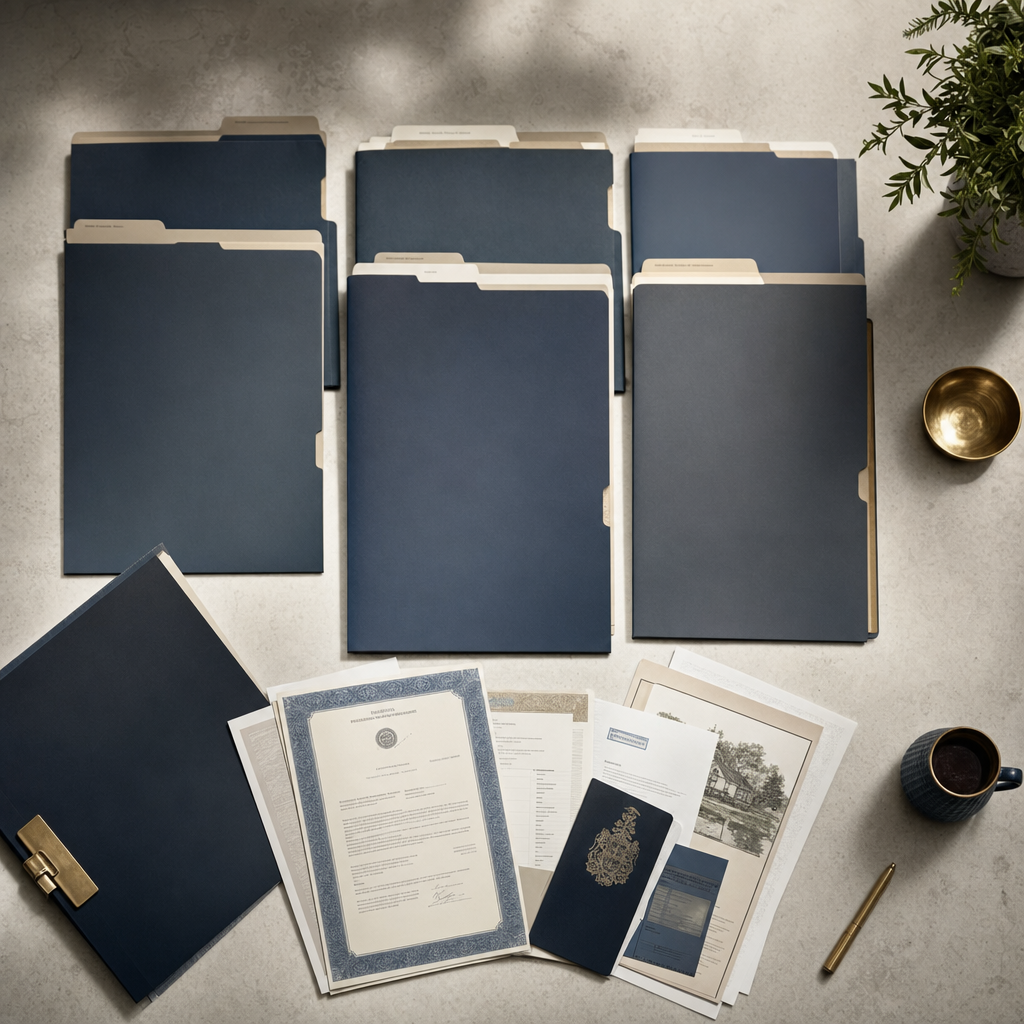
Imagine a Friday evening call: your father has been admitted to hospital, and the ward sister is asking whether he has a Lasting Power of Attorney in place. You know he made one, some years ago. You think it might be in a box file in his spare room. You are not certain.
That uncertainty, in a moment already full of fear, is entirely avoidable. It is also extremely common. Most households contain the right paperwork; they simply cannot locate it quickly when it matters. The list below is not exhaustive, but it covers the twelve documents that come up again and again in family emergencies, in probate, and in the quiet administration of an estate.
The twelve documents, and why each one earns its place
1. Passports. Identity checks arise at every significant moment: opening accounts, registering a death, dealing with a foreign property. Know where every household passport is, and note its expiry date.
2. Birth certificates. Original birth certificates are required for a surprising number of legal and administrative processes, including registering a death and applying for probate. Certified copies are acceptable in some contexts; originals are safer to keep.
3. Marriage or civil partnership certificate. Relevant to inheritance, next-of-kin status, pension nominations, and the grant of probate. If there has been a divorce, retain the decree absolute as well.
4. The will. A signed, witnessed original. Solicitors hold many wills for safekeeping, and the Probate Registry will also store one, but the family should know precisely where it is. A photocopy is not a will.
5. Lasting Powers of Attorney. There are two: one for property and financial affairs, one for health and welfare. Both must be registered with the Office of the Public Guardian before they can be used. Unregistered LPAs, or LPAs that exist only in draft, are of no immediate use in a crisis. Keep the registered originals, and note the registration reference numbers separately.
6. Property deeds and Land Registry documents. For registered land in England and Wales, the title is held digitally by HM Land Registry, and official copies can be obtained online. Even so, any transfer deed, lease, or restrictive covenant document is worth keeping in physical form, since the register entry summarises rather than reproduces everything.
7. Mortgage documentation. The original mortgage offer and any subsequent product transfer letters. These confirm the lender, the account reference, the term, and the rate. Essential if the property must be dealt with during incapacity or after death.
8. Life insurance and protection policies. Include the policy schedule, the insurer's name, and the claims contact. Note whether the policy is written in trust, which affects how quickly proceeds can reach a family without passing through probate.
9. Pension details. A note of every pension, including old workplace schemes. For defined benefit arrangements, keep the most recent annual statement. For defined contribution schemes, note the provider and policy number. Check that nomination of beneficiary forms are current and filed with each provider.
10. NHS number and medical summary. The NHS number is a consistent identifier across the health system. A brief medical summary, including current medications and known conditions, is valuable during any hospital admission or emergency.
11. National Insurance number documentation. The original NI card or any HMRC letter confirming the number. Required for dealing with HMRC on behalf of an estate, for pension claims, and for state benefit applications.
12. Utility and financial account references. Not a single document but a consolidated note: bank account numbers, sort codes, the name of an accountant or financial adviser, utility providers, and any standing direct debits of significance. After a death, the person administering the estate will spend weeks assembling exactly this information. Assembling it in advance is a small act of generosity.
A calm method for getting there
The barrier is rarely laziness. It is the absence of a system that feels proportionate to ordinary life. A few principles help.
Keep physical originals together in one fireproof location, whether a home safe, a solicitor's strongroom, or a bank safe deposit box. Do not scatter them across filing cabinets, drawers, and loft boxes.
Maintain a separate, secure index that tells a trusted person where each document physically lives, without reproducing the documents themselves. This index can be stored digitally, provided it is protected and accessible to more than one person.
Review the list once a year, in the same week, without exception. Passports expire. Wills become outdated after a marriage or the birth of a grandchild. LPA registrations take weeks; starting the process before it is urgent is the entire point.
Scan and store certified digital copies for reference, but remember that for most legal purposes, the original governs. A scanned will is not a substitute; it is a prompt to find the original.
Finally, tell someone. The index is worthless if only one person knows it exists. A spouse, an adult child, or a trusted adviser should know where the system lives and how to access it.
If you would like a structured place to record, organise, and share exactly this information with the people who may need it, Glenvault was built for that purpose. You can begin at glenvault.com/signup.
The private vault for your family
Documents, wealth and succession protocols in one quiet, encrypted home. Start free — no card required.
Sign up to Glenvault